Grid Logic Puzzles in the Same Family as Loop Fence Puzzle
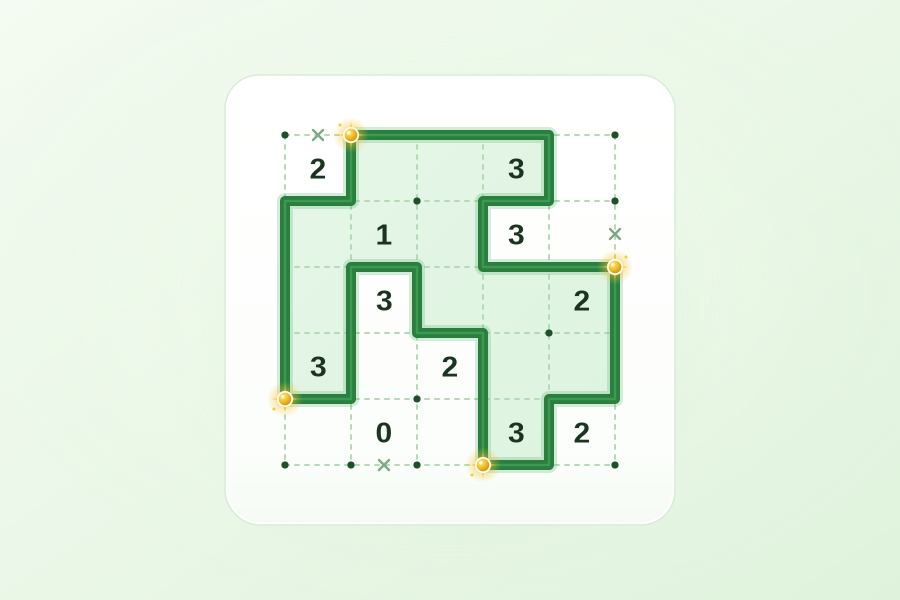
If you love the clean deductive flow of Loop Fence Puzzle (also known as Slitherlink or Fences), you are really enjoying a signature branch of Japanese Nikoli pencil puzzles: rectangular lattices where tiny local clues force one global topological structure. Below are the four closest cousins to Loop Fence Puzzle—each with its core rule, how its logic differs from Slitherlink, and how to bring those deduction habits back to your next board.
Masyu (Pearl Loop)
Core rule: Draw a single closed, non-intersecting loop through cell centers so the loop passes straight through every white pearl (turning immediately before or after) and makes a 90-degree corner on every black pearl (going straight for at least two cells on both legs).
How Masyu differs from Loop Fence Puzzle: Both Masyu and Slitherlink ask you to construct one continuous loop with zero crossings, zero branches, and zero premature mini-loops. The difference lies in how clues constrain the path. In Loop Fence Puzzle, 0–3 digits count edges around a square without caring whether the fence goes straight or turns; in Masyu, there are no numbers at all—every deduction comes from turn geometry and corridor length. Solvers who practice Masyu develop razor-sharp instincts for border reflections and sub-loop avoidance, which transfer directly when you return to our Loop Fence Puzzle board on 10×10 and 15×15 grids.
Hashi (Hashiwokakero / Bridges)
Core rule: Connect numbered island circles with horizontal or vertical bridges (at most two bridges between any pair of islands) so every island's bridge count matches its number and all islands form one single connected network without crossing bridges.
How Hashi differs from Loop Fence Puzzle: Where Loop Fence Puzzle builds a single closed boundary along grid edges, Hashi builds a connected graph—branches and dead-end islands are completely legal, while crossing lines remain forbidden. Like Slitherlink, Hashi begins with forced corner and border deductions (such as a corner 4 or an edge 6) and finishes with global connectivity checks that prevent isolated island clusters—the exact mirror image of sub-loop prevention in Slitherlink. If you enjoy counting exact edge capacities around numbered nodes, you will feel right at home jumping back into Loop Fence Puzzle or testing our loop fence puzzle rules.
Nurikabe (Islands in the Stream)
Core rule: Shade cells black to form one continuous, orthogonally connected "sea" containing no 2×2 black squares, while leaving unshaded white "islands" that each contain exactly one numbered cell equal to that island's area.
How Nurikabe differs from Loop Fence Puzzle: Instead of drawing edges between dots, Nurikabe partitions cells directly into two contrasting regions—sea and islands. Even though you never draw a line segment, Nurikabe exercises the exact same inside/outside parity thinking that advanced Slitherlink players use with Cell Shade mode. Learning to spot unreachable cells, narrow sea corridors, and illegal 2×2 pools in Nurikabe sharpens your spatial visualization for large 15×15 and 20×20 boards on Loop Fence Puzzle, especially when combined with the four patterns in our Loop Fence Puzzle strategy guide.
Yajilin (Arrow Loop & Shading)
Core rule: Shade cells black (no two black cells may share an edge) so every arrow clue accurately counts the number of black cells in its pointing direction, then draw one single closed loop through every remaining unshaded non-clue cell.
How Yajilin differs from Loop Fence Puzzle: Yajilin is a thrilling hybrid that merges cell shading with a single-loop path. Unlike Loop Fence Puzzle—where blank cells can sit either inside or outside the fence—every unshaded non-clue square in Yajilin must be visited by the loop, which creates intense parity constraints near corners and edges. Players who enjoy multi-step chain reactions and vertex degree-2 tracking in Yajilin love coming back to Hard-tier grids on Loop Fence Puzzle and tackling our Daily Loop Fence Puzzle.
 Slitherlink • Flagship